


Benchmarking plays a critical role in advancing healthcare organizations by providing insights into operational strengths and weaknesses, guiding quality improvements, and fostering the adoption of best practices. Its ultimate goal is to enhance efficiency, elevate patient care quality, improve health outcomes, and enrich the overall patient experience. This process involves systematically comparing organizational performance with industry standards and peer institutions to identify opportunities for growth and innovation.
The practice of healthcare benchmarking originated in the 17th century with outcomes comparisons like hospital mortality rates. However, it became a defining feature of healthcare management in the 1990s, evolving to encompass a broad spectrum of clinical and operational metrics. Today, benchmarking is an essential tool for measuring and comparing clinical results across organizations, promoting peer learning, and encouraging the implementation of proven strategies. For a deeper understanding of how technological advancements are transforming health services, see how cloud computing innovations are changing healthcare.
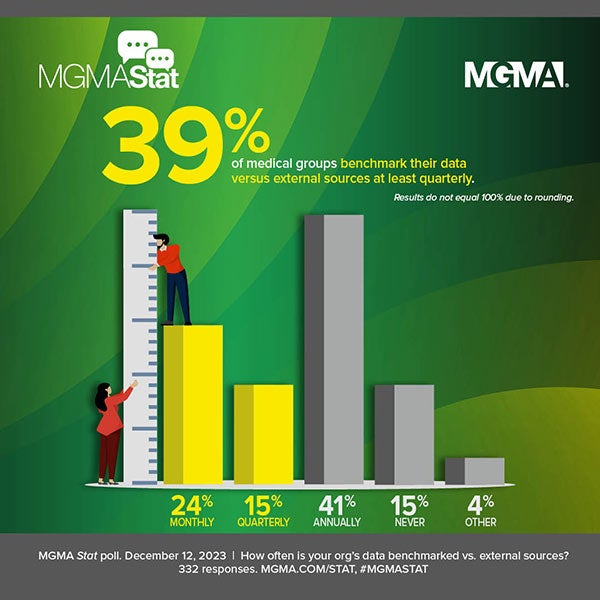
Healthcare leaders recognize the value of benchmarking in improving operational performance. Data from MGMA polls in 2019 indicated that a significant majority (84%) of healthcare executives utilized benchmarking data to enhance productivity, financial stability, human resources, and patient access. Despite its proven benefits, consistent benchmarking remains underutilized. A recent survey reveals that 41% of medical group leaders perform external benchmarking annually, while only 24% do so monthly. Some organizations—around 15%—rarely benchmark externally and tend to do so every two or three years. This infrequent practice limits the potential for continuous improvement and responsiveness to industry changes.
Why is benchmarking essential?
Benchmarking provides healthcare leaders with the data-driven foundation necessary for making informed strategic decisions. It reduces the risks associated with uncertainty and supports justifiable actions or inactions. As the saying goes, “If you don’t measure it, you can’t manage it,” emphasizing the importance of quantifying performance to enable effective management. Equally, organizations must value their metrics to drive meaningful change.
By engaging in regular benchmarking, healthcare organizations can foster growth through operational enhancements, increased efficiency, and cost reductions. It allows for meaningful comparisons against peer institutions across diverse metrics, helping identify and adopt best practices from high performers. Streamlining inefficient processes, eliminating redundancies, and optimizing resource allocation are all facilitated through insights gained from benchmarking. Top-tier organizations, such as those highlighted in the MGMA DataDive Better Performers dataset, excel because they continuously translate data into actionable strategies. They review their benchmarking results monthly, enabling them to track progress and adapt swiftly—an approach discussed in the importance of teamwork in healthcare.
Interesting:
Furthermore, ongoing benchmarking helps organizations see the bigger picture—understanding trends over time, recognizing persistent issues, and validating improvements. This continuous cycle of measurement and adjustment is vital for maintaining a competitive edge and achieving long-term excellence.
- For the latest insights, explore the 2023 MGMA DataDive Better Performers summary report, which offers benchmarks from top organizations with expert analysis, offering a comprehensive view of best practices in medical management in 2024.
MGMA’s dedication to benchmarking excellence
Since its inception in 1926, MGMA has specialized in delivering high-quality benchmarking data and industry statistics that empower healthcare providers to make smarter decisions. By gathering and analyzing extensive data through surveys, reports, and industry research, MGMA provides valuable insights that help medical groups set achievable goals across areas such as operational efficiency, financial health, staffing, and patient access.
Participating in MGMA’s annual DataDive surveys allows organizations to contribute data and receive detailed datasets in return—often complimentary for contributors—facilitating a continuous feedback loop for improvement. These surveys open each year on January 1, 2024, offering practices the chance to benchmark against peers and identify opportunities for growth. To deepen data analysis, organizations can upgrade their access to advanced tools available through the MGMA Data Suite, which includes the robust MGMA Analytics platform.
In addition, MGMA offers comprehensive reports and resources, such as the latest benchmarking reports that provide detailed industry trends, key performance indicators, and strategic insights. These resources are invaluable for organizations committed to continuous improvement and operational excellence.
By leveraging these tools and data, healthcare providers can better understand their standing in the marketplace, identify growth opportunities, and implement targeted strategies to elevate their performance. Engaging in regular benchmarking and data analysis remains a cornerstone of achieving practice excellence in a rapidly evolving healthcare landscape.