


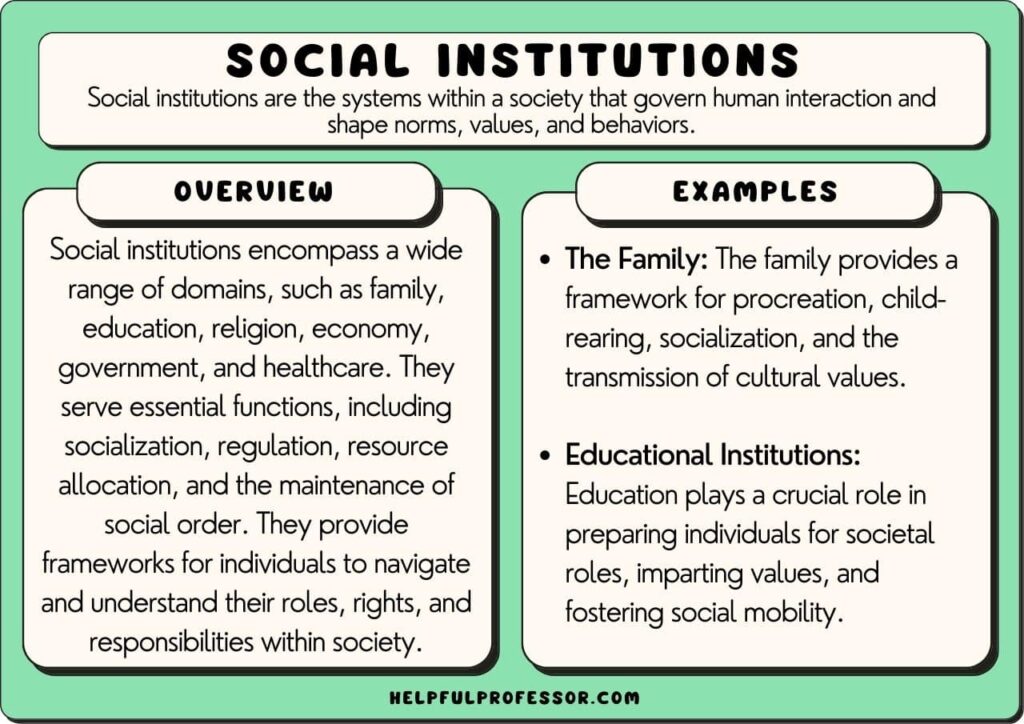
Social institutions form the backbone of any functioning society, providing the structured frameworks that establish norms, regulate behavior, and promote social cohesion. These enduring structures help societies organize their members, ensure stability, and facilitate socialization across generations. From family units to complex governmental systems, each institution plays a vital role in maintaining societal order and promoting collective well-being. Exploring these institutions offers insight into how societies operate, adapt, and evolve over time.
Examples of Social Institutions
1. The Family
The family remains one of the most fundamental social institutions, often regarded as the primary building block of society. It serves as the initial context where individuals learn social norms, values, and cultural practices. Families are responsible for nurturing, socializing, and caring for members, especially children, thus transmitting cultural heritage from one generation to another. The structure of families varies widely across different cultures and historical periods, ranging from nuclear families—comprising parents and children—to extended kinship networks involving grandparents, aunts, uncles, and cousins. Modern family forms also include single-parent households, blended families, and same-sex parent families, reflecting societal changes and increased diversity. Within this institution, individuals begin to understand gender roles, social status, and emotional bonds, laying the foundation for their future social interactions.
2. Education
Educational systems are crucial social institutions tasked with the systematic transmission of knowledge, skills, and cultural values. They prepare individuals to participate effectively in society and the economy. From early childhood education to higher education, these institutions structure formal learning experiences, awarding qualifications that open pathways to various careers. Beyond academic instruction, schools and universities foster social skills, critical thinking, and personal development, shaping societal norms and reinforcing cultural expectations. Education also plays a significant role in social mobility, providing opportunities for individuals to improve their socio-economic status. However, educational disparities often mirror broader societal inequalities, with access and quality varying based on socio-economic background or geographic location. More about the role of data in healthcare, including how it influences education and policy, can be explored in resources such as this detailed overview.
3. Religion
Religious institutions encompass organized systems of beliefs, rituals, and practices centered around spiritual and moral principles. These institutions include churches, mosques, temples, synagogues, and other faith-based organizations that serve as centers for worship, community gathering, and moral guidance. They profoundly influence cultural traditions, legal systems, and individual behaviors, often shaping societal norms and values. Religion fosters a sense of belonging, identity, and moral purpose among its adherents, providing support during times of crisis and uncertainty. However, religious institutions can also be sources of conflict, especially when divergent beliefs lead to social or political clashes. The influence of religious organizations extends into areas such as social justice, ethics, and even health policies, which increasingly intersect with healthcare systems. For instance, understanding how technological advancements impact health care delivery can be found in this resource.
4. Government and Politics
Political institutions organize the exercise of power and authority within society. Governments, legislative bodies, and political parties work together to create laws, enforce regulations, and maintain order. They are responsible for providing essential public services, such as infrastructure, education, and healthcare, as well as protecting citizens from external threats. The structure of political institutions varies globally—from democracies emphasizing citizen participation to authoritarian regimes with centralized control. These institutions influence resource distribution, social equity, and individual rights, thus shaping societal development. Their effectiveness directly impacts social stability and economic progress. A deeper understanding of how decision-making systems operate within healthcare can be explored through this discussion.
5. Economic Institutions
Economic systems and structures govern the production, distribution, and consumption of goods and services. They include banking systems, markets, corporations, labor unions, and regulatory agencies. These institutions determine how resources are allocated and wealth is generated, influencing overall economic stability and growth. Different economic models—capitalism, socialism, and mixed economies—shape societal priorities and social inequalities. The policies enacted by economic institutions impact employment levels, income distribution, and environmental sustainability, making them central to discussions on social justice and development. The dynamics of financial institutions like banks and investment firms are especially critical in shaping economic health and stability.
6. Healthcare System
Healthcare institutions are vital for maintaining and improving public health. They encompass hospitals, clinics, healthcare professionals, and regulatory agencies responsible for delivering medical services and managing health policies. Systems vary worldwide, with some countries adopting publicly funded models and others relying on private insurance frameworks. The healthcare sector is also a significant driver of economic activity, facing challenges such as rising costs, technological integration, and ensuring equitable access. Advances in health informatics and decision support systems are transforming patient care, emphasizing the importance of data-driven strategies in medicine. For insights into the role of data collection in health management, visit this resource.
7. Legal and Judicial System
The legal and judicial institutions uphold the rule of law by interpreting and enforcing laws through courts, judges, and law enforcement agencies. They serve as guardians of justice, ensuring that societal norms are maintained and individual rights protected. A fair and impartial justice system is fundamental to social stability, preventing chaos and fostering trust in governance. Issues such as legal accessibility, fairness, and the balance between security and liberty are ongoing concerns that influence societal perceptions of justice. The effectiveness of this institution ensures that conflicts are resolved lawfully, and societal order is preserved.
Interesting:
- Understanding the importance of duty of care in health and social services
- Understanding the role and impact of special investigative units sius in healthcare audits
- Understanding the role of encounters in medical billing
- Understanding the role of drgs in medical billing and reimbursement
- Understanding the fundamentals of clinical care in healthcare
8. Media and Communication
Media and communication organizations shape how information is created, shared, and consumed in modern society. Traditional outlets like newspapers, radio, and television coexist with digital platforms, including social media and blogs. These institutions are central to informing the public, influencing opinions, and holding other social institutions accountable. They also play a role in shaping cultural norms and political debates. The rise of digital media has revolutionized communication, enabling rapid dissemination but also raising concerns about misinformation, privacy, and digital divides. Understanding the influence of media is essential for grasping contemporary societal dynamics.
9. Art and Cultural Institutions
Art and cultural organizations serve as vital repositories and creators of societal values, history, and identity. They include museums, galleries, libraries, theaters, and literary institutions that preserve and promote cultural heritage. Beyond their societal role, they contribute significantly to the economy through tourism, entertainment, and publishing industries. These institutions foster creativity, critique social issues, and reflect societal transformations. Challenges include balancing preservation with innovation, managing funding constraints, and navigating globalization’s impacts on local cultures.
10. Non-Governmental Organizations (NGOs)
NGOs operate independently of government control to address social, environmental, and humanitarian issues. They range from local community groups to international agencies, engaging in activities such as disaster relief, human rights advocacy, environmental protection, and social justice initiatives. NGOs often fill gaps left by governmental services, advocating for marginalized populations and promoting sustainable development. They rely heavily on donations, grants, and volunteer work, facing challenges related to transparency, accountability, and navigating complex political environments.
11. Financial Institutions
Financial institutions—including banks, credit unions, and insurance companies—are crucial for economic functioning. They facilitate transactions, provide credit, safeguard savings, and support investment activities. These institutions underpin economic stability by implementing monetary policies, regulating financial markets, and promoting financial inclusion. Their operations influence employment, inflation, and overall economic growth. Adapting to technological innovations like digital banking and fintech is vital for maintaining stability and trust within financial systems.
12. Social Welfare Systems
Social welfare institutions are designed to provide support to those in need, ensuring social safety nets. They include programs like social security, unemployment benefits, housing assistance, and disability support. These systems aim to reduce poverty, promote social inclusion, and offer security during crises. The scope and effectiveness of welfare programs vary by country, reflecting different social values, economic resources, and policy priorities.
13. Public Administration and Bureaucracy
Public administration involves managing government agencies, policies, and programs to serve the public interest effectively. Bureaucracies are structured administrative systems tasked with implementing laws, delivering public services, and managing resources. Efficient public administration is essential for transparency, accountability, and effective governance. Challenges include reducing red tape, preventing corruption, and adapting to social and technological changes that influence governance practices.
Durkheim’s Perspective on Social Institutions
Emile Durkheim, a foundational figure in sociology, emphasized the importance of social institutions in maintaining societal cohesion through his theory of functionalism. Durkheim viewed institutions such as the family, religion, and government as vital organs in the social body, each performing specific functions necessary for societal health (Cam & Irmak, 2014). According to him, these institutions transmit shared values, uphold moral order, and prevent social disintegration (Riley, 2014). His analogy of society as a biological organism highlights how each institution contributes to overall stability and functionality, much like organs in a living body. Durkheim also recognized that social institutions are not static; they must evolve alongside societal changes to remain relevant and inclusive. For example, modern reforms in family structures reflect this adaptive perspective, emphasizing the need for institutions to realign with contemporary values.
References
- Browne, K. (2011). An Introduction to Sociology. Wiley.
- Cam, T., & Irmak, F. (2014). An overview of Durkheim and Merton’s social anomie. Journal of Human Sciences, 11(2), 1297-1305.
- Durkheim, E. (1915). The Elementary Forms of the Religious Life: A Study in Religious Sociology. Macmillan.
- Little, W., McGivern, R., & Kerins, N. (2016). Introduction to sociology-2nd Canadian edition. BC Campus.
- Macionis, J. & Plummer, K. (2005). Sociology: A global introduction. Pearson Education.
- Riley, A. (2014). The social thought of Emile Durkheim. Sage Publications.
- Shimran, K. (2018). Sociology. New Delhi: Educreation Publishing.
- For further insights into health system innovations, see this overview.