

Medical billing and provider reimbursement are complex systems built on standardized units that quantify the value of healthcare services. Among these, Relative Value Units (RVUs) serve as a fundamental measure used to determine how much healthcare providers are paid for their services. If you’re unfamiliar with the intricacies of medical billing, RVUs may seem confusing at first glance. However, understanding how they function can shed light on the mechanics behind healthcare reimbursements and provider compensation structures. This knowledge is essential not only for medical professionals but also for administrative staff, policy makers, and anyone interested in how healthcare economics work.
What are RVUs?
RVUs, short for Relative Value Units, are numerical scores assigned to medical procedures and services. These scores are determined by the Centers for Medicare & Medicaid Services (CMS) and form part of the Medicare resource-based Relative Value System. This system was established in 1989 and implemented in 1992 alongside the Medicare Physician Fee Schedule (MPFS). The primary purpose of RVUs is to create a standardized way to assign value and establish fair reimbursement rates across different types of healthcare services.
Each RVU reflects the estimated resources, effort, and costs involved in delivering a particular service. These include factors such as physician work, practice expenses, and malpractice insurance costs. By assigning these values, healthcare payers can ensure a more equitable and transparent compensation system. For a broader understanding of how healthcare systems operate, you can explore what is a healthcare system.
RVUs are integral to many countries’ healthcare models, but their calculation and application can differ widely depending on the system in place. For example, some nations have single-payer systems that standardize reimbursements differently, influencing provider incentives and patient access. To appreciate the variations in global health systems, consider reviewing which country has the best healthcare system.
What is the Purpose of an RVU?
Prior to the adoption of RVUs, medical providers were compensated based on individual fee scales, which often resulted in inconsistencies and perceived unfairness. Different providers might charge wildly different amounts for similar procedures, making it challenging for programs like Medicare to maintain fairness and transparency.
The introduction of RVUs helped standardize these valuations by providing a common metric. They recognize that different medical services require varying levels of effort, skill, and resources. For example, a routine check-up generally involves less time and complexity than a major surgical operation. Consequently, the RVUs assigned to these services reflect these differences, leading to more equitable reimbursement.
Furthermore, RVUs incorporate geographic adjustments through the Geographic Practice Cost Indices (GPCI). These adjustments account for regional differences in the cost of living and operational expenses, ensuring that providers in higher-cost areas receive appropriate compensation. This approach helps prevent underpayment in expensive regions and promotes fairness nationwide.
How to Determine RVUs for a Service in Medical Billing?
Calculating the RVU for a specific service involves understanding its three core components, each representing different aspects of healthcare delivery. These components are Physician Work, Practice Expense, and Malpractice Insurance costs. Here’s a detailed explanation of each:
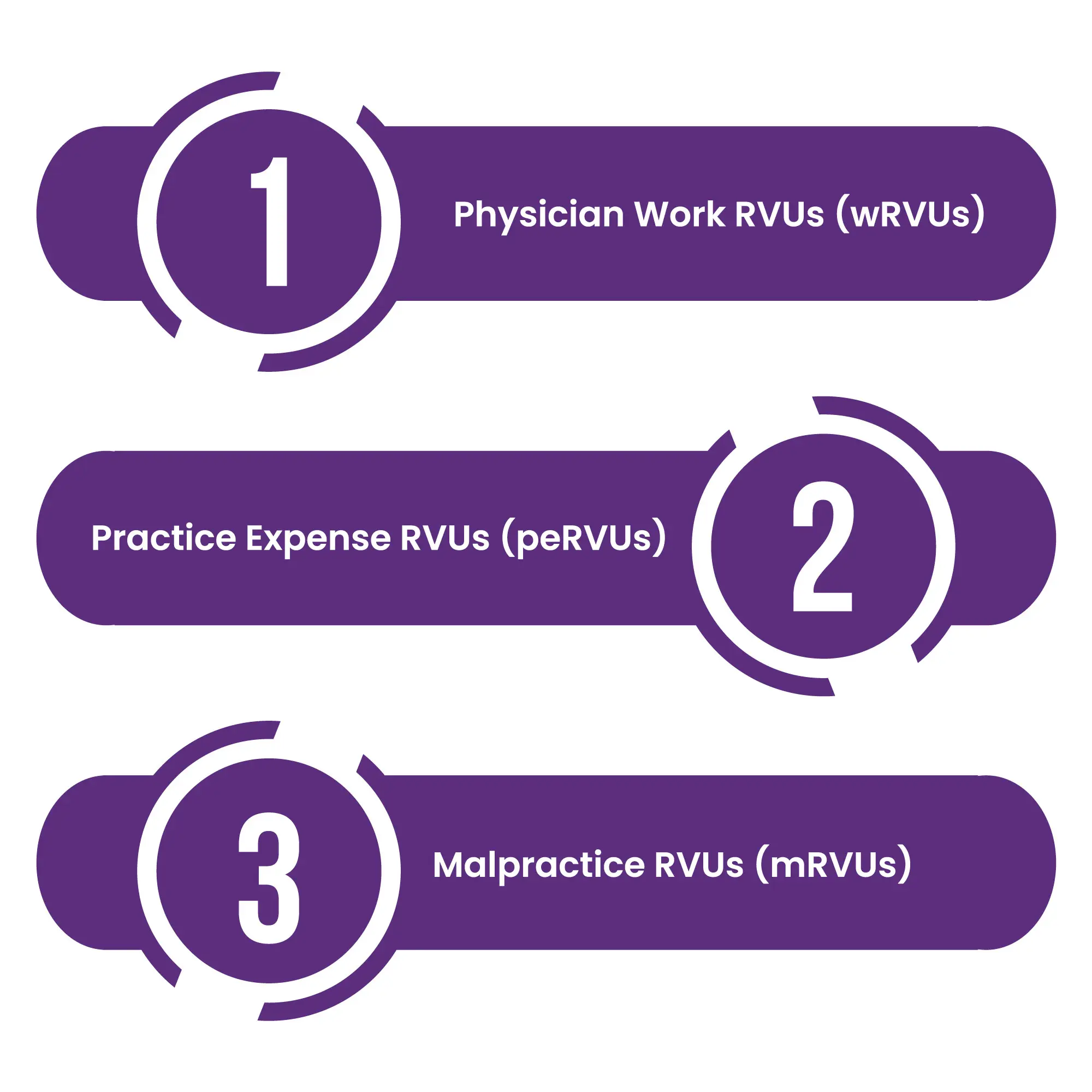

1. Physician Work RVUs (wRVUs)
This component measures the effort, skill, time, mental workload, and stress involved in providing a service. It accounts for the professional’s physical and mental contribution and responsibility. For instance, a complex surgical procedure will have a higher work RVU than a simple office visit, reflecting the extensive training and expertise required.
2. Practice Expense RVUs (peRVUs)
These RVUs cover the costs associated with maintaining a medical practice. Expenses include rent, staff salaries, medical equipment, and supplies. For example, advanced imaging procedures, such as MRI scans, incur higher practice expenses due to the expensive equipment and specialized staff involved, compared to routine consultations.
3. Malpractice RVUs (mRVUs)
This component estimates the liability costs for physicians, especially for invasive or high-risk procedures. For example, performing open-heart surgery involves substantial malpractice coverage, translating into higher malpractice RVUs compared to low-risk services like vaccinations.
Interesting:
- Understanding fee schedules in medical billing the key to transparent healthcare payments
- Understanding rac in healthcare a key to financial integrity and compliance
- Mastering rvus in medical billing a comprehensive guide to accurate calculation and strategic usage
- Understanding clinical document architecture cda a key standard in healthcare interoperability
| RVU Component | Description | Approximate Percentage |
|—————-|————–|————————|
| Physician Work RVUs | Time, effort, skill, and stress associated with the physician’s performance of a service. | 51% |
| Practice Expense RVUs | Overhead costs including staff, equipment, and supplies. | 45% |
| Malpractice RVUs | Cost of malpractice insurance based on service risk. | 4% |
How are RVUs Calculated?
Calculating RVUs involves summing the individual components and adjusting for geographic cost variations. The basic formula is:
Total RVU = Work RVU + Practice Expense RVU + Malpractice RVU
This total is then multiplied by a national conversion factor, set annually by CMS, to determine the reimbursement amount:
Reimbursement = Total RVU x Conversion Factor
Geographic Adjustments
Since costs vary across regions, the total RVU is often adjusted using the GPCI:
Geographically Adjusted Total RVU = (Work RVU x Work GPCI) + (Practice Expense RVU x Practice Expense GPCI) + (Malpractice RVU x Malpractice GPCI)
These adjustments ensure fair compensation regardless of location, preventing underpayment in high-cost areas and overpayment in lower-cost regions.
RVUs Per Hour and Per Visit
- RVUs Per Hour: To measure productivity, divide the total RVUs generated by the number of hours worked. This helps assess efficiency, especially when physicians are compensated based on output.
RVUs per Hour = Total RVUs / Total Hours Worked
- RVUs Per Visit: To evaluate work per patient, divide total RVUs by the number of patient visits within a certain period.
RVUs per Visit = Total RVUs / Total Patient Visits
Final Thoughts
An in-depth understanding of RVUs enhances transparency in healthcare reimbursement and provides insight into how providers are compensated for their work. It also emphasizes the importance of each component—physician effort, practice overhead, and malpractice costs—in shaping fair payment models. For healthcare professionals, grasping these concepts facilitates better practice management and negotiation strategies. For policymakers, it highlights the complexities in designing equitable healthcare systems, whether they resemble the more centralized models or are more fragmented, as seen in countries with diverse systems. Exploring why some healthcare systems face criticism can offer additional perspectives on how these valuation systems impact overall healthcare quality and access.