

Accurate healthcare billing and provider compensation depend on a clear understanding of how services are valued. Relative Value Units, commonly known as RVUs, form the backbone of this valuation system, especially within the U.S. Medicare framework. They serve as standardized metrics that quantify the effort, resources, and risk involved in delivering various medical services. By grasping the components and applications of RVUs, healthcare providers, administrators, and billing teams can better align clinical productivity with financial performance, ensuring fair reimbursement and efficient care delivery.
Key Components of RVUs in Healthcare
RVUs are constructed from multiple weighted factors, each representing different aspects of service provision. These components collectively determine the reimbursement value assigned to each clinical activity.
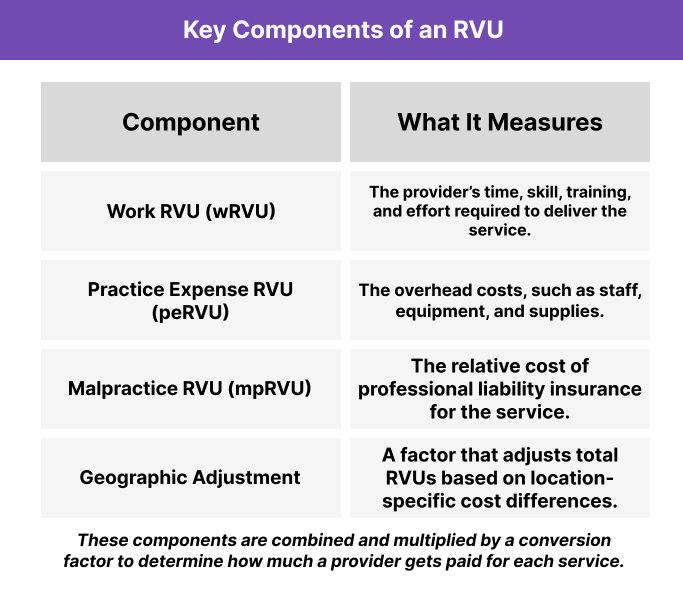
- Work RVU (wRVU): This element captures the physician’s time, skill, and effort required to perform a service. It reflects the direct clinical work involved and is crucial for measuring provider productivity.
- Practice Expense RVU (peRVU): This component accounts for the overhead costs associated with delivering care. It includes expenses such as staff salaries, medical supplies, equipment, and facility overhead.
- Malpractice RVU (mpRVU): This factor considers the liability insurance costs that providers incur when performing procedures or services.
- Geographic Adjustment: To accommodate regional cost variations, RVUs are adjusted based on the provider’s location, ensuring fair compensation regardless of geographic disparities.
Each of these elements contributes to determining what a provider is paid for their work. The calculation process involves detailed data and formulas, which are often explained through visual aids like this table outlining the components, helping clarify how reimbursement values are derived.
Benefits and Challenges of Using RVUs
Benefits of Integrating RVUs into Healthcare Payment Models
- Standardized Compensation: RVUs provide a consistent measure of clinical effort, enabling fair and transparent provider reimbursement.
- Enhanced Transparency: By using a common valuation system, administrators can compare service costs across different specialties and facilities more effectively.
- Productivity Monitoring: Tracking wRVUs allows organizations to set performance benchmarks, incentivize high-quality care, and manage provider productivity.
- Regional Fairness: Adjustments for geographic cost differences help tailor reimbursements, promoting equity across diverse locations.
Challenges Encountered When Relying on RVUs
- Complexity: Managing and understanding the multiple RVU components—wRVU, peRVU, and mpRVU—requires technical expertise and meticulous attention to detail.
- Potential for Misaligned Incentives: Overemphasis on volume-based RVU generation may inadvertently encourage unnecessary procedures, emphasizing quantity over value.
- Lagging Relevance: RVU assignments sometimes lag behind current clinical practices or care coordination needs, leading to discrepancies.
- Administrative Burden: Accurate coding, documentation, and compliance are essential, which can increase administrative workload and require ongoing oversight.
In practice, RVUs are central to many financial and operational decisions. For instance, exploring healthcare systems globally reveals how different countries approach service valuation, while in Sweden, detailed analyses of their healthcare framework shed light on alternative models. Understanding these systems can inform improvements and innovations within your own organization.
How RVUs Operate in Daily Practice
In routine healthcare settings, RVUs serve as a foundation for evaluating provider productivity and determining reimbursement. Services are assigned RVUs based on CPT codes, which are then multiplied by a conversion factor—set annually by CMS—to calculate the actual payment. For example, a typical office visit with a CPT code 99213 might have an RVU value of approximately 1.30. Multiplying this by the current conversion rate yields the dollar amount reimbursed.
This process applies across different clinical activities, whether analyzing service profitability, benchmarking workloads among specialists, or structuring incentive plans. Even in evolving value-based care models, RVUs remain a vital metric for balancing clinical quality with financial sustainability.
How Are RVUs Used for Provider Reimbursement?
RVUs are integral to translating clinical services into payments, particularly under Medicare’s Physician Fee Schedule (MPFS). Each billable service, identified by specific CPT or HCPCS codes, is assigned a total RVU based on three primary factors: work effort, practice expenses, and malpractice risk.
Reimbursement Calculation
The basic formula for reimbursement is straightforward:
Total RVU × Conversion Factor = Reimbursement
Interesting:
- Understanding rvus in medical billing a key to healthcare compensation
- Understanding good faith estimates in healthcare billing
- Understanding the meaning of rcm in medical billing and its role in healthcare finance
- Preventing costly mistakes understanding and combating double billing in healthcare
- Understanding the role and impact of special investigative units sius in healthcare audits
- The conversion factor is a dollar amount set annually by CMS; for example, in 2024, it was approximately $32.74.
- RVUs are adjusted within this formula for regional differences using the GPCI (Geographic Practice Cost Index) to reflect local cost variations.
- This adjustment ensures that providers in higher-cost areas receive appropriate compensation, making the system equitable.
Practical Example:
Suppose CPT code 99214 has a total RVU of 2.60, and your region’s GPCI adjustment results in an effective RVU of 2.70. With a 2024 conversion factor of $32.74:
2.70 × $32.74 = approximately $88.36
RVUs are also used to evaluate productivity, structure compensation models, and analyze the cost efficiency of services. This systematic approach promotes fairness and transparency in healthcare reimbursement.
Frequently Asked Questions about RVUs
1. What does an RVU represent in healthcare?
An RVU quantifies the relative value of a specific medical service, reflecting the effort, resources, and risk involved. It is a standardized metric that influences provider reimbursement levels, particularly under programs like Medicare.
2. How are the different components of RVUs determined?
Each CPT or HCPCS code is assigned values for work effort (wRVU), practice expenses (peRVU), and malpractice costs (mpRVU). These are combined and multiplied by a dollar-based conversion factor to derive the total RVU for billing purposes.
3. Why are RVUs significant for healthcare providers?
RVUs serve as a measure of productivity, influence compensation structures, and help determine payer reimbursements for services rendered. They are essential for financial planning and operational efficiency.
4. How does a wRVU differ from a total RVU?
A wRVU captures only the provider’s direct effort, such as time and skill. In contrast, the total RVU encompasses additional costs like overhead and malpractice insurance, providing a comprehensive valuation.
5. Are RVUs used outside of Medicare?
Yes. While Medicare heavily depends on RVUs for reimbursement calculations, many private insurers and healthcare organizations also incorporate RVU models to structure provider contracts and monitor productivity.
Understanding these elements can help healthcare professionals and administrators improve their operational strategies and ensure that compensation aligns fairly with clinical effort.