






Racial Considerations in Clinical Diagnosis and Treatment: Challenges and Opportunities
 December 24, 2025
Understanding how racial categories influence medical decision-making is essential in advancing equitable healthcare. Although race is a social construct without a biological basis, it continues to shape clinical practices, often reinforcing outdated notions and perpetuating disparities. This overview explores the complex role race plays in medicine, from its historical roots to modern implications, emphasizing the importance of moving toward race-conscious approaches that prioritize social determinants and individual health profiles.
Issue Brief
Introduction
Race, as a socio-political classification, lacks a biological foundation but remains embedded in healthcare practices. It influences clinical decisions through various channels such as implicit biases among providers, disease stereotypes, and the use of algorithms and guidelines that incorporate racial categories. While some health conditions are more prevalent in populations with certain genetic ancestries, these genetic factors are poorly aligned with socially defined racial groups. Relying on race to inform diagnoses or treatment can reinforce false biological assumptions and sustain racial health disparities. This briefing provides an in-depth look at the significance of race in clinical settings and discusses its implications for health equity and disparities reduction.
Background: Use of Race to Explain Health Differences
Despite the absence of biological evidence, the medical community has historically used race to interpret differences in disease prevalence and outcomes. The concept of race originated within Western societies as a hierarchical system to justify colonialism, oppression, and discrimination against non-European populations. In American medical education, these ideas fostered theories of racial inferiority and white supremacy, contributing to atrocities such as forced sterilizations of women of color, the exploitation of Henrietta Lacks’ cells without consent, and the infamous Tuskegee Syphilis Study. Although current research has largely discredited biological racial differences, some recent studies continue to suggest genetic factors may play a role in health disparities. For instance, an article published in 2020 initially proposed that unmeasured genetic influences might explain the increased severity of COVID-19 among Black populations; later revisions clarified that societal determinants are more likely responsible. Recent findings indicate that demographic and socioeconomic variables often better explain disparities in cardiovascular outcomes than genetic differences.
Calls against using race solely as a biological explanation have intensified, emphasizing the importance of recognizing the role of racism. Scientific consensus now acknowledges race as a social rather than biological category. Genetic studies reveal more variation within racial groups than between them, challenging the validity of race-based assumptions. Critiques within the scientific community advocate for research that distinguishes the impacts of racism from race itself, aiming to prevent the reinforcement of disproven biological notions and to better address the social roots of health inequities.
Accurate race and ethnicity data remain vital for identifying and addressing disparities. However, healthcare systems face persistent challenges with incomplete or inaccurate demographic data, including misclassification within electronic health records (EHRs). These inaccuracies are particularly pronounced among Hispanic populations and can hinder efforts to understand and eliminate disparities.
Race in Clinical Decision-Making and Treatment
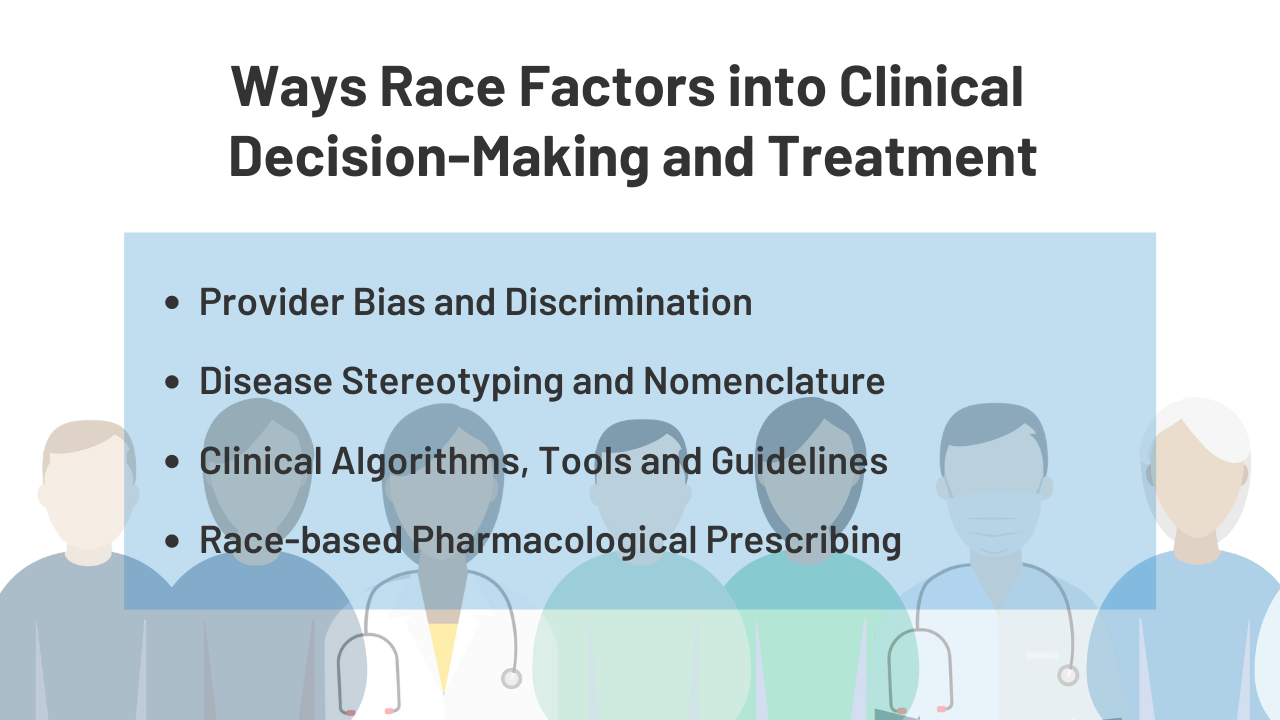
Provider Bias and Discrimination
Research consistently demonstrates that provider and institutional biases contribute significantly to racial disparities in healthcare. These biases influence diagnosis, prognosis, and treatment decisions, often leading providers to perceive and treat patients differently based on race. For example, studies show that healthcare providers historically view Black patients as less cooperative or associate Hispanic patients with noncompliance and risky behaviors. A systematic review from 2015 revealed that many providers harbor implicit biases favoring White patients and negative stereotypes about patients of color. These biases can manifest in pain management disparities, with providers systematically underestimating pain levels reported by Black patients, resulting in undertreatment. Similarly, providers endorsing false beliefs about biological differences may administer less pain relief to Black patients or deny necessary care.
Patients also report unfair treatment linked to race or ethnicity. A 2020 survey found that Black and Hispanic adults are more likely than White adults to experience discrimination or negative interactions with healthcare providers. Black patients often report feeling their concerns are not believed or that they are refused treatment or pain medication they believe they need. Additionally, racial and ethnic minorities face greater difficulty finding providers who understand their backgrounds and treat them with dignity.
Disease Stereotyping and Nomenclature
Medical education often employs imprecise racial labels and stereotypes that can distort understanding of disease. Lectures and clinical vignettes frequently use broad racial categories (e.g., Black, Asian) as proxies for genetic or socioeconomic factors, leading to misconceptions. For example, clinicians might associate cystic fibrosis primarily with White populations, overlooking its occurrence in Black or Hispanic individuals. Conversely, conditions such as G6PD deficiency, which affects diverse racial groups but is often emphasized as a disease of African or Middle Eastern descent, may be mischaracterized. Similarly, skin conditions like Lyme disease are often depicted on White skin, delaying diagnosis in darker skin tones. Racialized terminology in disease names, such as “Mongolian spot” or “Mongolism” for Down syndrome, perpetuates xenophobic stereotypes, although there has been a move toward more precise and descriptive language. The use of geographic terms like “China virus” for COVID-19 further fueled anti-Asian sentiment and discrimination, illustrating how disease nomenclature can reinforce harmful biases.
Interesting:
- Exploring medical careers for felons opportunities and challenges in 2025
- Harnessing big data to revolutionize healthcare opportunities challenges and strategic considerations
- Embracing service oriented architecture in medical software opportunities and challenges
- Exploring medical careers for felons opportunities and challenges in the healthcare sector
- Navigating the challenges and opportunities of ai integration in healthcare
Use of Race in Clinical Algorithms, Tools, and Guidelines
Incorporating race into clinical algorithms can unintentionally perpetuate disparities. Many risk calculators and diagnostic tools include race as a factor, often leading to differential thresholds or assessments. For example, estimated glomerular filtration rate (eGFR) calculations commonly apply a racial correction factor for Black patients, which can delay kidney disease diagnosis and treatment. Similarly, pulmonary function tests adjust for race, potentially underestimating lung disease severity in Black or Asian patients. These practices risk both over- and under-treatment, depending on the context.
Research reveals that some clinical tools are less accurate or misapplied in diverse populations. Pulse oximeters tend to be less precise in darker skin, leading to missed hypoxemia diagnoses. In pediatrics, bilirubin measurements may be unreliable in infants with darker skin, risking unnecessary interventions or missed diagnoses of neonatal jaundice. Dermatologic training often lacks images of lesions on darker skin, impairing diagnosis and management of serious conditions like sepsis or melanoma in people of color. Moreover, skin cancer diagnoses tend to occur later in Black and Hispanic populations, leading to worse outcomes.
The expansion of artificial intelligence (AI) and algorithms in healthcare necessitates caution. If trained on biased datasets, AI tools can exacerbate existing disparities. For example, an algorithm designed to identify patients with complex health needs was found to underestimate risk in Black patients because it used healthcare costs as a proxy, which are often lower due to barriers to access. Careful development and validation are critical to ensuring AI reduces, rather than reinforces, inequities.
Race-based Pharmacological Prescribing Guidelines
Some medications are prescribed differently based on racial assumptions, often with limited scientific backing. The drug BiDil, approved in 2005 specifically for Black patients with heart failure, exemplifies race-based pharmacotherapy, despite critiques that it oversimplifies genetic diversity. Other examples include lower starting doses of antihypertensives like hydrochlorothiazide or statins such as Crestor for Asian patients, based on studies with limited diversity. These practices are controversial because they risk misclassification and may perpetuate stereotypes.
Pharmacogenomics aims to personalize medicine by genetic profiling but often relies on racial categories as a proxy. While this approach can potentially improve treatment efficacy, it is hampered by underrepresentation of minority populations in research and the extensive genetic variation within racial groups. Consequently, reliance on racial classifications may obscure more precise genetic factors influencing drug response, limiting the promise of truly individualized therapy.
Implications
The pervasive use of race in clinical diagnosis and treatment can reinforce false biological notions and impede efforts to address social and structural determinants of health. Biases among healthcare providers, disease stereotypes, and race-based algorithms contribute to disparities in quality of care and health outcomes. Continuing to treat race as a biological variable neglects the role of racism and social inequities, hindering progress toward health equity.
Efforts are underway to revise practices and policies. The American Medical Association (AMA) has adopted policies recognizing race as a social construct and encourages curricula that address the harms of race-based medicine. Several institutions have removed race correction factors from kidney function estimates, and professional societies are developing guidelines to diagnose diseases without race-based adjustments. Moving forward, education, increased diversity among healthcare providers, and rigorous evaluation of clinical tools are vital in reducing racial biases. As the use of sophisticated algorithms expands, ensuring these tools are equitable and free from bias is essential for advancing just and effective healthcare.
For further insights, explore how healthcare systems analyze payor data and the differences between UK and US healthcare approaches. Additionally, understanding how to implement equitable healthcare models can benefit from resources like guides to healthcare trusts for employers.