


A comprehensive understanding of risk mitigation strategies is critical in complex systems across industries such as healthcare, aviation, and engineering. The Swiss Cheese Model stands out as a powerful conceptual tool that visually explains how layered defenses can work together to prevent failures. This model emphasizes that no single safety measure is infallible; instead, it relies on multiple overlapping layers to catch errors before they escalate into disasters. By examining how these layers interact and where vulnerabilities might exist, organizations can develop more robust safety protocols and foster a proactive safety culture.
The Swiss Cheese Model is more than just a metaphor—it’s a practical framework for analyzing risks, designing safety systems, and continuously improving operational resilience. Whether you’re involved in patient safety, aviation security, or industrial safety, understanding this model helps in identifying weak points and implementing effective safeguards. Its principles are applicable globally, from hospitals striving to improve patient outcomes to nuclear facilities aiming to prevent catastrophic accidents.
This guide explores the origins, functioning, applications, and limitations of the Swiss Cheese Model, offering insights into how it can be integrated into your organization’s safety and risk management strategies.
What Is the Swiss Cheese Model?
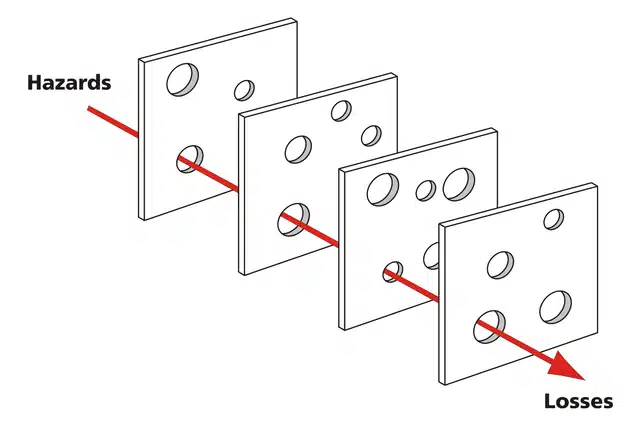
Created by psychologist James Reason in the 1990s, the Swiss Cheese Model serves as a conceptual map for understanding how errors occur in complex systems. It illustrates that safety is maintained through multiple defensive layers—each represented by a slice of Swiss cheese. These layers include policies, procedures, training, technological safeguards, and organizational culture. However, each layer has its own imperfections, depicted as holes or gaps in the cheese.
The core idea is that errors or failures can pass through these holes if they align across multiple layers, leading to adverse events. The key to effective risk management is ensuring that the holes in one layer do not line up with those in others, thus preventing errors from reaching the final goal or causing harm. When properly implemented, this layered defense approach significantly reduces the probability of failures, even if individual measures are imperfect.
The concept underscores the importance of designing systems where vulnerabilities in one layer are compensated by strengths in others. It recognizes that human and mechanical errors are inevitable, but their impact can be minimized through redundancy and overlap in safety measures. For a deeper understanding of the broader context of health systems, you might explore which country has the best healthcare system, or learn about the fundamental components of healthcare infrastructure at what is healthcare system.
How the Model Works
Imagine stacking several slices of Swiss cheese, each with irregular holes scattered throughout. When these slices are aligned, some holes may line up, creating pathways through which errors or hazards can pass. These perforations symbolize vulnerabilities within each safety layer—such as human mistakes, equipment failures, or lapses in protocol adherence.
The effectiveness of this layered setup depends on the distribution of the holes. Since the gaps are typically random and uncorrelated across layers, the probability that they line up perfectly is low. Consequently, a flaw in one layer is unlikely to result in failure because subsequent layers act as additional barriers. This overlapping redundancy ensures that even if one layer is compromised, others remain intact to prevent disaster.
For example, in aviation, multiple safety checks and protocols—pilot training, maintenance routines, air traffic control procedures—work collectively to prevent accidents. If a pilot makes an error, subsequent layers such as automated systems and crew communication serve as additional safeguards. This collective approach exemplifies how the model’s layered defense strategy minimizes risk.
Applications of the Swiss Cheese Model Across Industries
Healthcare
In healthcare, patient safety is paramount. Each step in patient care—from diagnosis to medication administration—is a potential point of failure. The Swiss Cheese Model helps providers identify weak spots at every stage, enabling targeted improvements. For instance, implementing multiple verification steps for medication dosages or surgical site identification creates layered safeguards that reduce errors.
Hospitals often employ this model during incident investigations to pinpoint where communication breakdowns or procedural lapses occurred. By strengthening these weak points, healthcare facilities can prevent adverse events and improve overall care quality. For more insights into healthcare safety systems, visit what is a healthcare system.
Aviation
The aviation industry exemplifies rigorous safety culture, heavily relying on the Swiss Cheese Model. Multiple independent layers—pilot training, aircraft maintenance, safety protocols, and air traffic control—interact to ensure flight safety. Investigations into aviation accidents frequently reveal that failures in one layer could have been caught or mitigated by others, preventing catastrophic outcomes.
In this high-stakes environment, systematic probing of each layer helps identify vulnerabilities before they result in accidents. Regular drills, checklists, and communication protocols are designed as overlapping defenses, ensuring continuous safety even when individual layers encounter issues.
Interesting:
Engineering
Safety-critical fields like nuclear and chemical engineering prioritize layered risk management strategies. The Swiss Cheese Model guides engineers to incorporate multiple safety barriers—such as containment systems, control mechanisms, and emergency procedures—to prevent accidents. If one barrier fails, others are still in place to contain or mitigate hazards.
In these domains, meticulous design and regular safety audits are essential. Such proactive measures prevent large-scale disasters, illustrating the model’s value in highly sensitive sectors. Despite its simplicity, critics acknowledge that the model may not fully capture the complexity of interconnected systems, but it remains a useful starting point for safety improvements.
Benefits of the Swiss Cheese Model
Enhanced Safety
By emphasizing the importance of multiple overlapping defenses, the Swiss Cheese Model greatly improves organizational safety. It encourages organizations to identify vulnerabilities within each safety layer and implement measures that complement one another. This approach reduces the likelihood that a single failure will lead to an incident, making systems more resilient. For an overview of global healthcare standards, see which country has the best healthcare system.
Improved Error Management
The model promotes a proactive stance towards error detection and correction. Organizations adopting this framework develop stronger mechanisms for identifying potential failures early, allowing for timely interventions. This systematic approach decreases both the frequency and severity of errors, fostering a culture of continuous safety enhancement.
Fostering a Culture of Continuous Improvement
One of the most significant strengths of the Swiss Cheese Model is its ability to instill ongoing safety refinement. Organizations use it as a tool for failure analysis, regularly reviewing and strengthening their safety barriers. This mindset encourages teams to proactively anticipate and address potential issues, ensuring defenses remain robust over time. A proactive safety culture is crucial, and methods like what is a single payer system in healthcare support continuous improvement efforts.
Limitations of the Swiss Cheese Model
While highly effective, the Swiss Cheese Model is not without its critics. Some argue that it oversimplifies the complexities of modern, interconnected systems. In highly dynamic environments, errors can travel along multiple pathways not fully represented by static layers. Critics caution that the model’s visual simplicity may overlook the nuanced interactions and feedback loops in contemporary systems.
Despite these limitations, the model remains a valuable tool for initiating safety assessments and designing layered defenses. It serves as a foundational framework, which can be complemented with other analytical methods for comprehensive risk management.
Real-World Examples of the Model in Action
Aviation Incident Analysis
In aviation safety investigations, the Swiss Cheese Model is instrumental in dissecting accidents. After an incident, investigators trace the failure across multiple layers—pilot actions, maintenance records, communication protocols, and system redundancies. They identify where holes aligned, allowing hazards to penetrate defenses. This analysis informs targeted improvements, such as enhanced pilot training or revised safety procedures, to prevent future occurrences.
Healthcare Quality Assurance
Hospitals utilize the Swiss Cheese Model during root cause analyses of adverse events. For example, if a medication error occurs, teams examine each safety layer—prescription checks, pharmacy verification, administration protocols—to identify weaknesses. Addressing these gaps reduces the risk of recurrence, ultimately improving patient outcomes. The model’s visual approach simplifies complex safety data, making it easier to implement effective corrective actions.
Incorporating the Swiss Cheese Model in Daily Operations
Risk Assessment
Applying this model during routine risk evaluations helps organizations visualize their processes as multiple layers, each with potential vulnerabilities. By systematically identifying and strengthening weak points, organizations can prevent errors before they happen. For example, manufacturers can use the model to detect flaws along production lines and implement controls that overlap to ensure product quality.
Training and Awareness
Educating staff about the principles of the Swiss Cheese Model fosters a safety-conscious mindset. Training programs that emphasize layered defenses encourage employees to recognize potential failure points early and take preventive actions. For instance, cybersecurity teams trained in this model may better detect abnormal behaviors signaling a breach, thereby safeguarding sensitive data.
Conclusion
The Swiss Cheese Model is among the most straightforward yet impactful approaches to risk management. Its universal applicability across sectors highlights the importance of layered defenses in safeguarding operations and lives. By visualizing safety as multiple overlapping slices, organizations can identify weaknesses, implement redundancies, and foster a culture of continuous safety improvement. For organizations aiming to elevate their safety standards and minimize hazards, adopting this strategic perspective on vulnerabilities is essential.
Implementing such frameworks not only enhances safety but also promotes resilience and proactive problem-solving, essential qualities in today’s complex operational environments. To explore how different countries manage healthcare systems, consider reviewing which country has the best healthcare system. Embracing these principles can lead to safer, more reliable operations across all industries.