






Essential Digital Tools for Healthcare Professionals in 2025
 December 23, 2025

Streamlining healthcare delivery relies heavily on the right digital applications designed specifically for medical professionals. As technology advances, these tools become indispensable for managing workflows, ensuring compliance, and enhancing patient care. In an era where efficiency and accuracy are paramount, choosing the appropriate apps can significantly impact outcomes and organizational success. This comprehensive guide explores the top apps healthcare providers should consider in 2025, highlighting their features, benefits, and how they integrate into daily clinical practice.
Our Top Picks
- 1. Connecteam — The All-in-One Healthcare Workforce Platform
- 2. Medscape — Extensive Medical Reference for Clinicians
- 3. Epocrates — Streamlined Drug Interaction and Decision Support
Why Trust Our Recommendations?
Our team of unbiased app reviewers adheres to strict editorial standards, ensuring that all evaluations are transparent and based on thorough testing. Our methodology emphasizes real-world usability, security, and value, providing healthcare professionals with reliable guidance. You can review our complete methodology for more insight into how we select these top tools.
How We Selected the Best Apps for Healthcare Professionals
Evaluating healthcare applications involves assessing critical features that support clinical practice and operational efficiency. Our selection process focused on:
Essential Features
- Data Security and Compliance: Ensuring adherence to HIPAA standards with encrypted, secure logins and data protection.
- Employee Scheduling and Time Tracking: Facilitating efficient management of shifts, attendance, and overtime.
- Certifications and Skill Management: Monitoring staff qualifications and expiration dates of certifications.
- Centralized Employee Records: Maintaining contact details, HR files, and department information in one accessible platform.
- Secure Internal Communication: Allowing instant, encrypted messaging between staff and management for urgent updates and coordination.
Usability and Flexibility
- User-Friendly Interface: Minimizing learning curves so staff can quickly adopt new tools.
- Customizability: Allowing adaptation to various team structures and healthcare settings.
Additional Features for Differentiation
- Knowledge Management: Easy access to policies, procedures, and training materials.
- Reporting & Analytics: Tracking staffing patterns, overtime, and operational trends.
- Document Storage: Organizing HR and compliance documents securely.
The Top Healthcare Apps of 2025
Connecteam — The Most Comprehensive All-in-One Platform
Connecteam stands out as a versatile workforce management system that consolidates scheduling, time tracking, and secure communication into a single, intuitive app. Its mobile-first design ensures staff can access essential features from anywhere, supporting the dynamic needs of healthcare teams.
Why choose Connecteam: Its high level of customization and broad feature set simplify complex scheduling, compliance, and communication tasks. The platform’s thoughtful automation tools, such as AI-powered scheduling, help reduce administrative burdens and improve accuracy. For example, the AI auto-scheduler considers staff availability, qualifications, and labor laws, generating compliant shift plans with minimal manual input.
Learn more about the healthcare system in Canada and how it compares globally.
Scheduling Made Effortless
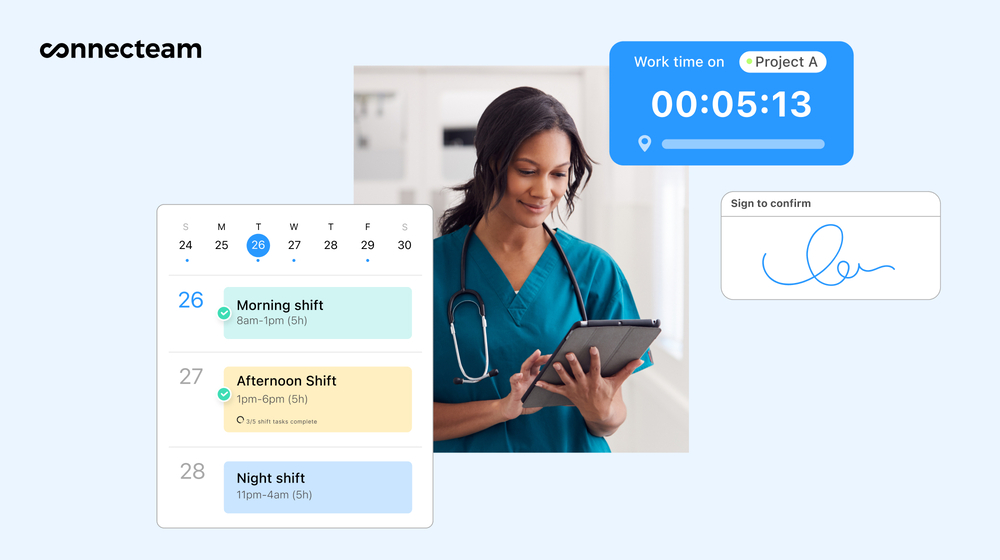
Connecteam’s scheduling module handles intricate shift patterns with ease, allowing managers to create templates or build schedules from scratch. Staff can submit availability and preferences via mobile, which streamlines the process. Once schedules are published, automatic notifications keep everyone informed. When shifts need to be swapped or filled unexpectedly, managers can drag-and-drop or employees can request changes directly within the app. Coverage gaps are visible at a glance, preventing understaffing.
The AI-driven scheduler uses role-based algorithms to generate optimal staffing plans, factoring in qualifications and legal restrictions to ensure compliance. This feature reduces manual planning time and minimizes human error.
Accurate Time and Attendance Tracking
The app’s time clock feature enables staff to clock in and out via their smartphones, with optional GPS and geofencing to verify locations. If an employee forgets to punch out, the system automatically records their departure based on geofence exit. Breaks, overtime, and absences are logged automatically into timesheets, simplifying payroll processing.
Real-time attendance reports help managers identify trends like frequent tardiness or coverage shortages before they impact operations. These insights support proactive staffing adjustments.
HIPAA-Compliant Messaging
Secure messaging within Connecteam allows staff and managers to communicate instantly about shift updates, patient care, or urgent issues. Messages are encrypted and stored securely, maintaining compliance with privacy regulations. Features include individual chats, group messaging, and organizational announcements, all protected to uphold confidentiality.
Seamless Integration
Connecteam offers API connections to existing hospital systems and third-party tools, ensuring smooth workflow integration. It also supports uploading employee documents, tracking certification expirations, and maintaining a centralized knowledge base for policies and procedures.
Watch this testimonial from UK-based Caremark to see how they leverage Connecteam to enhance their healthcare operations! The platform offers a free plan for life, ideal for small teams, with premium options starting at $29/month for up to 30 users.
Key features:
- Drag-and-drop scheduling
- GPS time clock
- Automated conflict detection
- Encrypted communication tools
- Real-time alerts
- Employee directory
Pros:
- All-in-one platform for workforce management
- HIPAA-compliant security
- Intuitive user interface
- Strong compliance tools
Cons:
- Some integrations still in development
Medscape — Comprehensive Medical Reference for Clinicians
Available on web, iOS, and Android, Medscape provides instant access to a vast repository of clinical information, making it an essential resource for healthcare providers seeking quick, reliable data.
Why Medscape? Its extensive database includes drug references, disease guides, clinical tools, and medical news, all designed for point-of-care decision-making. The platform covers over 8,000 drugs with detailed dosing, contraindications, and interaction data. Its drug interaction checker helps prevent adverse medication conflicts, an essential safety feature.
Further insights into Canada’s healthcare system can be found here.
Decision Support and AI Assistance
Medscape’s recent addition of the Scribe feature employs AI to generate real-time, HIPAA-compliant summaries of patient visits, reducing documentation time. Currently available for U.S. physicians, this tool streamlines charting and allows clinicians to focus more on patient interaction.
Medical News and Continuing Education
The platform keeps clinicians updated with the latest breakthroughs, FDA approvals, and research highlights. It offers CME/CE credits across numerous specialties, with an activity tracker to monitor progress and maintain compliance.
Deep Clinical Library
Over 6,200 articles on diseases, diagnostics, and treatments support evidence-based practice. Each entry is regularly updated and organized by specialty, providing a trusted resource for clinicians at the bedside.
User feedback:
“When we adopted Medscape, our clinical decision-making improved dramatically.”
Explore Canada’s healthcare structure to understand different healthcare models worldwide.
Epocrates — Efficient Drug and Treatment Support
Available on iOS and Android, Epocrates offers trusted drug information, interaction checks, and clinical guidelines suitable for both routine and complex cases.
Why Epocrates? Its comprehensive drug monographs include prescribing instructions, contraindications, and adverse reactions. The interaction checker supports multiple medications simultaneously, providing clear explanations to prevent harmful interactions.
You can learn how Canada’s healthcare system functions to see how apps like Epocrates complement clinical practice globally.
Interesting:
Disease Management and Labs
The premium Epocrates+ plan grants access to detailed disease insights, diagnostic pathways, and treatment algorithms, aiding clinicians in managing less familiar conditions. It also features a comprehensive lab reference section with test ranges, preparation instructions, and interpretation tips, expediting diagnostic workflows.
Clinical Guidelines and Updates
The app delivers timely safety alerts, new drug approvals, and evidence-based guidelines, ensuring clinicians stay current with evolving standards.
Pricing: Starts at $179.99 per user annually, with no free trial available.
MDCalc — Evidence-Based Calculators and Decision Tools
This platform offers a wide array of clinical calculators and risk scores, supporting accurate, evidence-based decision-making at the bedside.
Why MDCalc? It simplifies complex calculations, such as the CHA₂DS₂-VASc stroke risk score or Wells’ criteria for pulmonary embolism, backed by published research. Tools are organized by diagnosis, prognosis, or treatment, making them easy to access during patient encounters.
For more on healthcare systems, see here.
Decision Support Embedded in Clinical Practice
Each calculator provides clear instructions, interpretation guidance, and clinical context. For example, the Glasgow Coma Scale helps in assessing neurological status, directly influencing management decisions.
Specialty Filters and Workflow Integration
Tools can be filtered by specialty, streamlining access for cardiology, emergency medicine, nephrology, and others. MDCalc also offers EHR integration, allowing providers to embed calculators into their documentation workflows and earn CME credits through related activities.
Pricing: Contact vendor for details; most tools are free.
WikEM — A Quick-Reference for Emergency Medicine
WikEM is an open-access, community-updated wiki dedicated to emergency medicine, providing rapid access to protocols, procedures, and clinical guidelines.
Why WikEM? Its content is contributed by frontline emergency practitioners, ensuring relevance and accuracy. With over 3,900 pages, it covers common and rare ED conditions with practical management strategies.
Learn more about emergency medicine here.
Community-Driven Content and Offline Access
The platform’s wiki format ensures that content remains current, reflecting the latest practice standards. Its mobile app supports offline use, critical for settings with unreliable internet. The search function is fast and intuitive, enabling quick retrieval of information during high-pressure situations.
Additional Resources
WikEM also offers directories for residency and fellowship programs, journal club listings, and specialty resources, making it valuable for training and ongoing professional development.
Doximity — Secure Communication and Telehealth
Doximity provides a HIPAA-compliant platform for clinician networking, secure messaging, and telehealth services, supporting seamless care coordination.
Why Doximity? Its trusted network allows providers to connect with colleagues, share referrals, and access professional news. Its secure messaging and calling features protect patient data while facilitating instant communication.
To see how the U.S. healthcare landscape compares globally, review here.
Telehealth and Scheduling
Doximity’s telehealth features include encrypted video calls and virtual visit management. It also offers scheduling via its acquisition of Amion, which allows on-call and shift planning, though this is a separate platform. This separation can lead to fragmented workflows, lacking integrated time and attendance tracking.
AI and Workflow Optimization
The platform incorporates AI tools like Doximity GPT, assisting with drafting documentation and administrative tasks while maintaining compliance. Its secure faxing and messaging ensure data privacy and regulatory adherence.
Pricing: Contact vendor; no free tier.
Doxy.me — Simple, Secure Telemedicine
This browser-based telehealth platform simplifies virtual visits, requiring no downloads or logins for patients, making it accessible for diverse populations.
Why Doxy.me? Its ease of use, with virtual waiting rooms, customizable branding, and automated reminders, enhances patient engagement. Features include screen sharing, group calls, and virtual backgrounds, suitable for various clinical scenarios.
More about the Canadian healthcare system can be explored here.
Security and Compliance
Fully HIPAA, GDPR, and SOC 2 Type 2 compliant, Doxy.me offers end-to-end encryption. Its free plan includes Business Associate Agreements, ensuring legal compliance. Paid plans provide analytics dashboards for monitoring utilization and optimizing telemedicine services.
Comparing Top Healthcare Apps
| Application | User Ratings | Starting Price | Free Trial | Free Version | Core Use Cases | Platforms |
|————–|————–|——————|————–|————–|—————-|———–|
| Connecteam | 4.8 | $29/month for 30 users | Yes (14 days) | Yes, up to 10 users | Workforce management, scheduling, communication | Web, iOS, Android |
| Medscape | 3.7 | Free | No | Yes | Medical references, CME | Web, iOS, Android |
| Epocrates | 4.6 | $179.99/year | No | No | Drug info, interactions, guidelines | iOS, Android |
| MDCalc | N/A | Contact vendor | No | No | Clinical calculators, decision support | Web, iOS, Android |
| WikEM | N/A | Free | No | Yes | Emergency medicine quick-reference | iOS, Android |
| Doximity | 4 | Contact vendor | No | No | Secure messaging, telehealth, networking | Web, iOS, Android |
| Doxy.me | N/A | Starts at $29/user/month | No | Yes | Telemedicine visits | Browser-based |
Exploring Apps Tailored for Healthcare Professionals
Healthcare apps serve to enhance clinical workflows, improve patient safety, and streamline administrative tasks. They centralize critical data, facilitate secure communication, and provide decision support tools that are vital in modern healthcare environments. These applications are designed to integrate seamlessly with existing hospital systems, ensuring data accuracy and security.
Apps like Connecteam exemplify how integrated platforms can support scheduling, compliance, and communication—all critical components for effective healthcare delivery. They operate by aggregating data, automating routine tasks, and providing instant access to essential resources, empowering clinicians to focus more on patient care.
Benefits of Implementing Healthcare Apps
- Accelerated Clinical Decisions: Instant access to drug interactions, disease guidelines, and diagnostic tools accelerates diagnosis and treatment planning.
- Enhanced Patient Outcomes: Reliable references and decision support lead to more personalized and evidence-based care.
- Streamlined Communication: Secure messaging and collaboration tools reduce miscommunication and foster team cohesion.
- Operational Efficiency: Automated scheduling, reminders, and workflow integration save time and reduce administrative burdens.
- Error Reduction: Automation of documentation and medication management minimizes human errors, safeguarding patient safety.
- Regulatory Compliance: Built-in security features ensure adherence to privacy standards like HIPAA, maintaining organizational integrity.
Cost Considerations for Healthcare Applications
Pricing varies based on features, team size, and usage. Many platforms employ per-user subscription models, ranging from approximately $14 to $29 monthly, with some offering free tiers for smaller teams. Larger organizations may benefit from flat-rate plans that provide full functionality without escalating costs. For example, Connecteam’s free plan supports up to 10 users, making it highly accessible for small practices, while premium plans accommodate larger teams with comprehensive features at competitive prices.
Frequently Asked Questions
- What types of apps are essential for healthcare providers? They include electronic health records (EHR), telemedicine, medication management, and staff scheduling tools.
- How is data secured in these apps? Through encryption, role-based access, secure cloud storage, and compliance with standards such as HIPAA.
- Can these apps integrate with existing hospital systems? Yes, many platforms offer APIs and third-party integrations to sync with EHRs and other clinical tools.
- What training is available for staff? Many apps provide tutorials, webinars, and onboarding guides to facilitate adoption.
- What is the return on investment? Improved efficiency, reduced errors, better compliance, and enhanced patient care contribute to significant organizational benefits.
Final Thoughts
In today’s fast-paced healthcare landscape, the right digital tools are crucial for delivering high-quality, efficient patient care. Apps like Connecteam exemplify how comprehensive, secure, and user-friendly solutions can empower healthcare teams to operate smoothly. Whether managing schedules, accessing medical references, or conducting virtual visits, these applications are transforming clinical workflows and setting new standards for healthcare excellence. Embracing these technologies ensures organizations stay competitive, compliant, and focused on what matters most—patient well-being.